
Restaurant inventory: a system that survives a busy week
Most restaurant stock systems collapse because they are too ambitious. Here is a smaller one that actually gets done — what to count, how often, and which numbers are worth acting on.
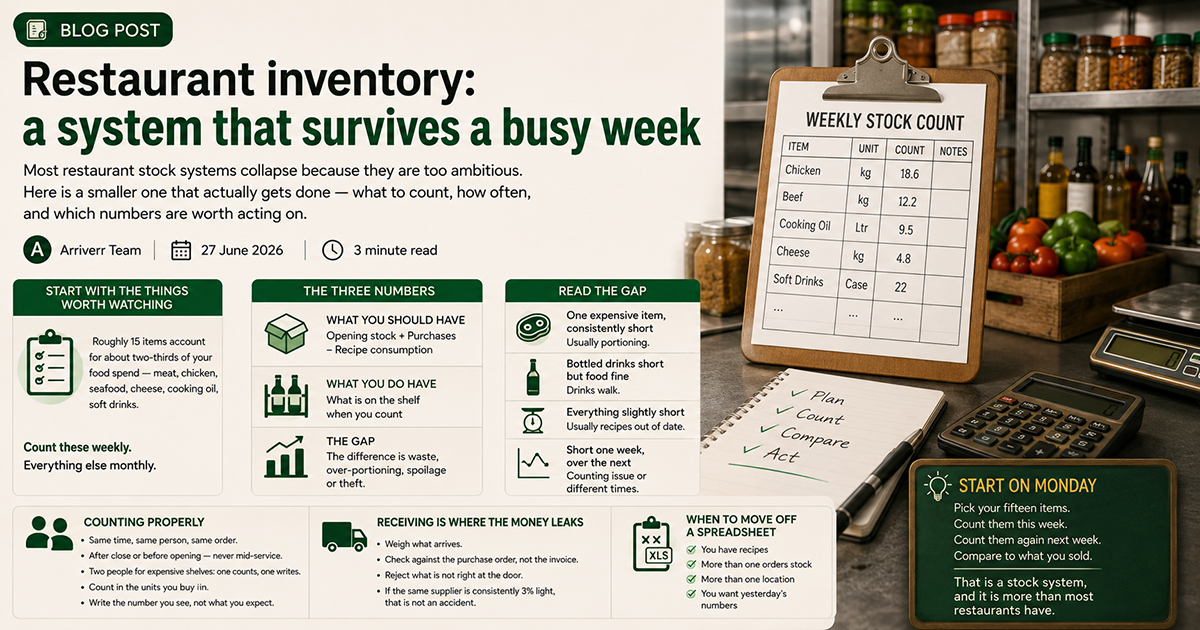
Most restaurant stock systems fail because they try to track everything. The one that works tracks the fifteen things that matter closely and everything else loosely — and it gets done every week, which is the only property that counts.
Start with the things worth watching
Sort every ingredient by what you spend on it in a month. You will find that roughly fifteen items account for about two-thirds of your food spend. Meat, chicken, seafood, cheese, cooking oil, and — in most restaurants — soft drinks.
Those fifteen get counted every week. Everything else gets counted monthly. Salt does not need a weekly audit.
The three numbers
What you should have
Opening stock, plus what you purchased, minus what your recipes say the sales consumed.
What you do have
What is on the shelf when somebody counts it.
The gap
The difference is waste, over-portioning, spoilage or theft. This is the number the whole exercise exists to produce. Everything else is bookkeeping.
Reading the gap
The pattern tells you the cause.
- One expensive item, consistently short — usually portioning. Weigh a few plates during service.
- Bottled drinks short but food fine — drinks walk. They are small, valuable and easy to carry.
- Everything slightly short — usually recipes that are out of date rather than anything sinister.
- Short one week, over the next — somebody is counting badly, or counting at different times of day.
Investigate before concluding. A short count is a question, not an accusation, and treating it as an accusation is how you lose good staff.
Counting properly
Same time, same person, same order, every time. After close or before opening — never mid-service. Two people for the expensive shelves: one counts, one writes. Count in the units you buy in, and let the software do the conversion to grams.
Write the number you see. The single most common failure in stock control is somebody writing what they expect rather than what is there, because the count "looks wrong".
Receiving is where the money leaks
More stock discrepancy starts at the back door than in the kitchen. Weigh what arrives. Check it against the purchase order, not against the invoice — the invoice is the supplier's claim, the PO is your agreement. Reject what is not right at the door, because arguing about it two days later never works.
If the same supplier is consistently 3% light, that is not an accident.
When to move off a spreadsheet
A spreadsheet is fine while one person orders, cooks and counts. It stops being fine when:
- You have recipes and want to know a dish's real cost
- More than one person orders stock
- You have more than one location
- You want yesterday's numbers rather than last month's
At that point the value is not the counting — it is that every sale deducts its ingredients automatically, so the "what you should have" number is live rather than reconstructed at month end.
Start on Monday
Pick your fifteen items. Count them this week. Count them again next week. Compare to what you sold. That is a stock system, and it is more than most restaurants have.
Try it on your own restaurant
Everything described here is in the software. A 7-day trial opens immediately, with no card.