
Menu engineering: finding the dishes that are quietly costing you
Every menu has four kinds of dish. Sorting yours into them takes an afternoon and usually finds one popular item making almost nothing — here is the method.
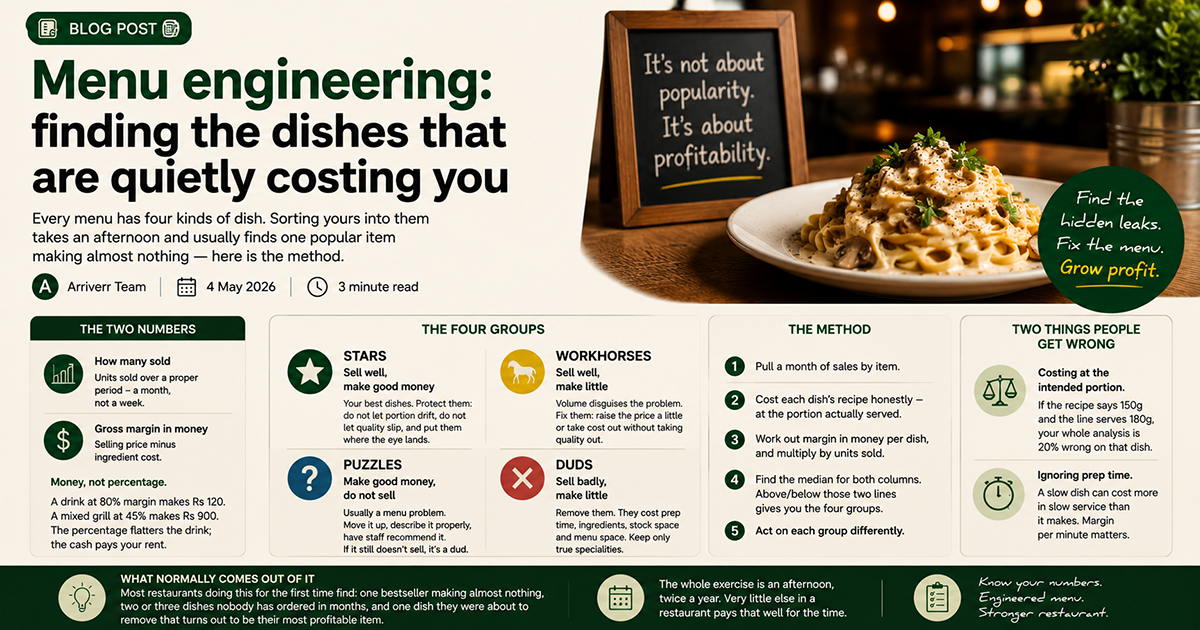
Every dish on your menu is one of four things. Sorting them takes an afternoon with a sales report and your recipe costs, and it almost always finds a popular dish making nearly nothing — the one you would never have suspected, because it sells so well.
The two numbers
For each dish you need how many sold over a proper period — a month, not a week — and gross margin in money, which is the selling price minus the ingredient cost.
Money, not percentage. This matters. A drink at 80% margin makes Rs 120. A mixed grill at 45% makes Rs 900. The percentage flatters the drink; the cash pays your rent.
The four groups
Stars — sell well, make good money
Your best dishes. Protect them: do not let the portion drift, do not let quality slip, and put them where the eye lands. Resist raising the price much — these are why people come.
Workhorses — sell well, make little
The dangerous group, because volume disguises the problem. A biryani selling 400 a month at Rs 90 margin looks like a hit and is making less than a starter selling 80 at Rs 400.
Fix them rather than removing them. Raise the price a little — a popular dish can usually take 5–10% without anyone noticing. Or take cost out without taking quality out: a cheaper cut cooked longer, a garnish nobody eats.
Puzzles — make good money, do not sell
Good dishes nobody orders, and the usual cause is the menu, not the food. Buried in the wrong section, badly described, or priced beside something that makes it look expensive.
Move it up. Describe it properly. Have the staff recommend it for a fortnight. If it still does not sell after that, it is a dud and you have learned something cheaply.
Duds — sell badly, make little
Remove them. Each one costs prep time, ingredients that go off, a stock line to count, and space on the menu. The only exceptions are dishes that genuinely bring people in — a house speciality, or the one thing a regular group always orders. Be strict about how many of those there really are.
Doing it
- Pull a month of sales by item.
- Cost each dish's recipe honestly — at the portion actually served, not the one written down.
- Work out margin in money per dish, and multiply by units sold.
- Find the median for both columns. Above/below those two lines gives you the four groups.
- Act on each group differently.
Two things people get wrong
Costing at the intended portion. If the recipe says 150g and the line serves 180g, your whole analysis is 20% wrong on that dish. Weigh a few plates first.
Ignoring prep time. A dish with a good margin that takes twenty minutes and blocks a station during the rush may be costing you more in slow service than it makes. Margin per minute is a real consideration in a kitchen at capacity.
What normally comes out of it
Most restaurants doing this for the first time find: one bestseller making almost nothing, two or three dishes nobody has ordered in months, and one dish they were about to remove that turns out to be their most profitable item.
The whole exercise is an afternoon, twice a year. Very little else in a restaurant pays that well for the time.
Try it on your own restaurant
Everything described here is in the software. A 7-day trial opens immediately, with no card.