
Where restaurant money actually goes missing
Most restaurant losses are not dramatic theft. They are six small, ordinary gaps — and each has a specific control that closes it without turning the place into a police station.
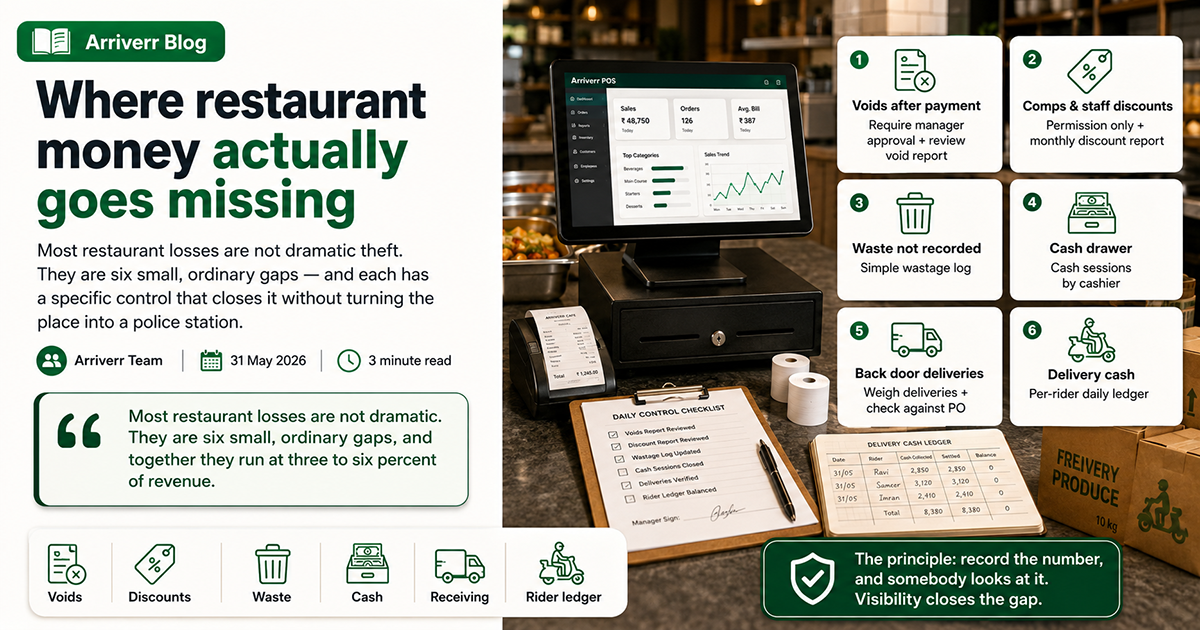
Most restaurant losses are not dramatic. Nobody is carrying a lamb out of the back door. They are six small, ordinary gaps, and together they run at three to six percent of revenue — which on Rs 4,000,000 a month is Rs 120,000–240,000 that simply is not there.
Each has a specific control. None of them requires treating your staff as suspects, and the ones that do tend to cost more in turnover than they save.
1 · Voids after payment
What happens: the order is rung up and paid in full. Afterwards a line is voided. The till shows a smaller total and the difference stays in a pocket.
The control: voiding after payment should require a manager's permission, and every void should appear on a report somebody reads. Not to catch people — to make it visible, which is usually enough.
2 · Comps and staff discounts
What happens: a discount is applied to a paying customer's bill and the difference is taken in cash. Or friends eat free, quietly and often.
The control: discounts as a permission, not a habit. A report showing discounts by staff member for the month. One person appearing far more often than the rest is a conversation, not necessarily a crime — sometimes it is the person who serves the most difficult tables.
3 · Waste that never gets written down
What happens: a tray dropped, a batch overcooked, prep that did not sell. None recorded. It shows up as a stock gap that looks exactly like theft.
The control: a wastage log that takes ten seconds. If recording waste is harder than hiding it, it will be hidden — and then you cannot tell honest waste from anything else.
4 · The cash drawer
What happens: small amounts, most shifts. Individually deniable.
The control: cash sessions. Each cashier opens with a counted float and closes with a counted total, and the difference is recorded against their name — not quietly corrected. A recurring shortfall on one person's shifts is a pattern; a recorded shortfall of Rs 50 is a rounding error, and treating the two the same is how you lose good cashiers.
5 · The back door
What happens: deliveries short-weighted, or received by whoever is nearest with no check. Over months this is often the largest single loss and nobody thinks of it as theft.
The control: weigh what arrives, check it against the purchase order rather than the invoice, and have one named person responsible per shift. A supplier who is consistently 3% light is not being careless.
6 · Delivery cash
What happens: a rider collects cash on delivery and hands over what they remember.
The control: a per-rider daily ledger — what they took out, what they collected, what they spent on fuel, what they hand back. Reconciled at the end of the shift while the day is fresh, not on Sunday from memory.
The principle underneath all six
Every one of these is closed by the same thing: the number is recorded, and somebody looks at it. Not surveillance — visibility. Most of what goes missing in a restaurant goes missing because nobody would have noticed, and staff know exactly which numbers are watched.
Put the controls in place before you have a problem, apply them to everyone including yourself, and they read as how the place is run rather than as an accusation. Put them in after you suspect someone and they read as exactly what they are.
Try it on your own restaurant
Everything described here is in the software. A 7-day trial opens immediately, with no card.